When to Start Botox: Age, Signs, and What to Know
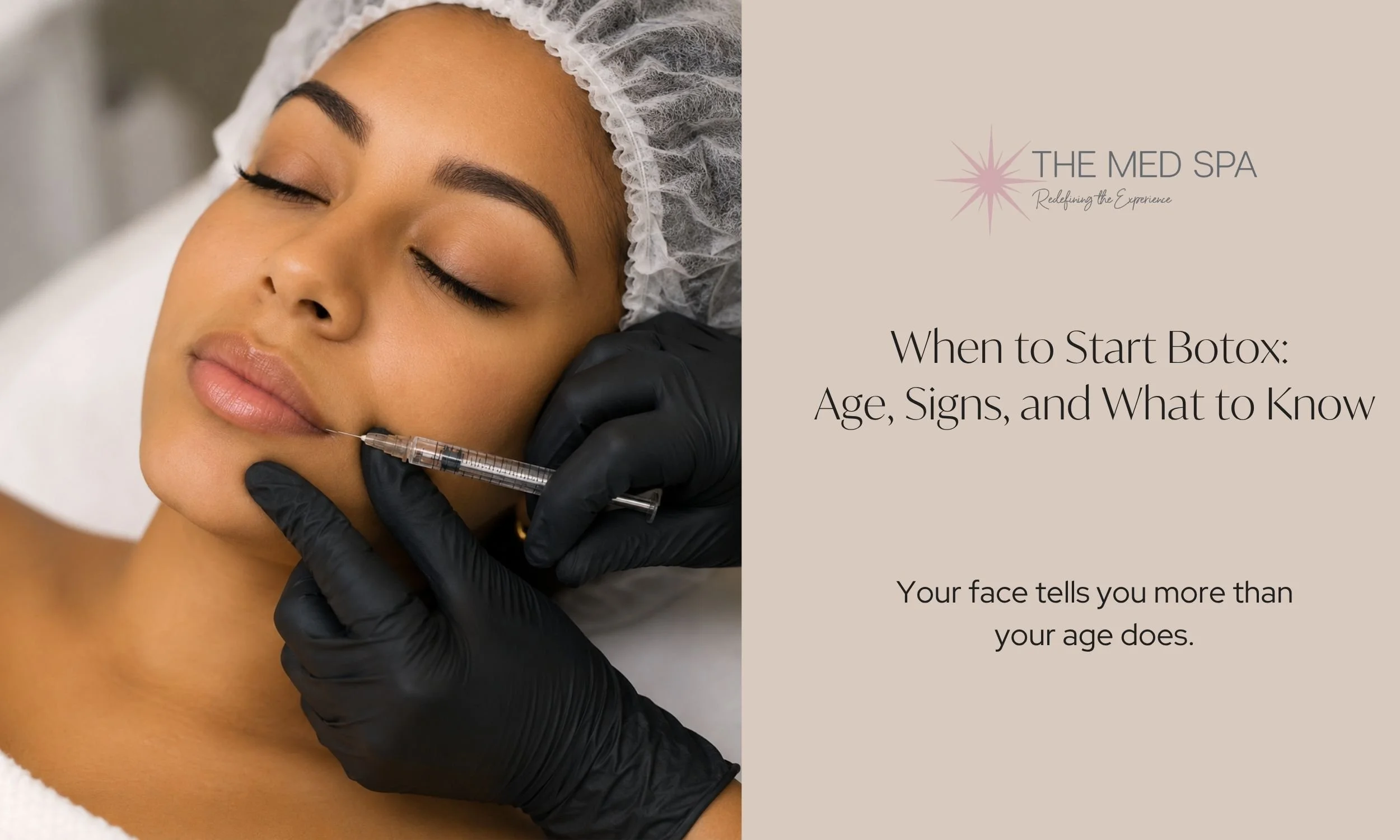
Forget the birthday math!
Pay attention to what your skin does when your face moves, and what's still there once you relax. That tells you a lot more than your age ever will.
Some people start noticing lines in their late 20s. Others don't think about Botox until their 40s or later, and both are completely normal. Figuring out when to start Botox comes down to your own face, at the end of the day.
What Determines When to Start
Your face moves in its own way, and that's the biggest piece of the puzzle. Botox targets dynamic wrinkles, the lines that show up when you smile, squint, frown, or raise your eyebrows. Here's what shapes your timeline more than your age does:
Facial movement
Strong, expressive muscles tend to create lines earlier. If your movement is more subtle, you could go decades without deep ones.
Genetics
Your skin thickness and collagen structure are pretty much baked in from the start.
Sun exposure and habits
UV rays break down collagen over time, and smoking or skipping skincare can speed that up.
Your own goals
Botox is optional. You might want to soften early lines, or you might love your expression lines exactly as they are. Either way, it's your call.
Signs Your Skin Might Be Ready
Your lines tell you more than the calendar does. Here's what to watch for:
Lines that only show when you move. Forehead lines, frown lines, crow's feet, and bunny lines that disappear once your face relaxes are dynamic wrinkles, the type Botox handles well.
Lines that stick around after you relax. When a crease stays visible even at rest, it's become a static wrinkle. Botox can still soften it by easing the movement that keeps folding the skin, though a deeply set line may only partly fade.
Makeup settling into creases. Foundation collecting in small lines around your forehead or eyes is often the first clue, sometimes before you even notice the line itself.
If any of this sounds like you, bring it up at your next consultation.
Another situation where you may consider Botox outside of typical wrinkles is if you sweat a lot. It can be quite frustrating to have hyperhidrosis, and so we also offer Botox solutions for you to get rid of excessive sweating. Read more here.
What is Preventative Botox?
Preventative Botox means starting before your lines turn into permanent creases. Every time you frown or raise your eyebrows, you're folding the same skin over and over. Ease up on that movement early, and you can help keep those creases from settling in for good.
That's why some people start in their late 20s, even without visible wrinkles yet. Their forehead or frown lines move strongly enough that treatment now can save them a deeper crease later.
One thing to keep in mind: Botox can't do everything. It won't stop collagen loss, volume changes, skin laxity, sun damage, or pigmentation, since none of those come from muscle movement. Sunscreen and good skincare still carry plenty of weight here. Even Vogue says that preventative Botox flags another downside: overdoing it in your 20s can weaken your forehead muscles over time!
Botox by Decade
Age ranges are more of a rough guide than a rulebook when it comes to figuring out when to start Botox. Here's roughly how it plays out decade by decade:
| In your 20s | Usually about catching strong, early movement before it turns into a permanent line. |
| In your 30s | Expression lines commonly start lingering after your face relaxes, so treatment often blends prevention with softening lines that already show. |
| In your 40s | Neurotoxins still work well here. Deeper, established creases may only partly soften, since Botox relaxes muscles and doesn't resurface skin. |
| In your 50s | Volume loss and skin laxity often play as big a role as expression lines, along with texture changes, so Botox tends to work best as one part of a broader plan. |
What to Expect at Your First Appointment
Your injector starts by watching your face in motion: smiling, squinting, raising your brows, frowning, then relaxing. This shows them which lines are dynamic, which stay at rest, and where your muscle movement is strongest.
Small amounts of Botox go into the targeted muscles. Expect mild redness, swelling, tenderness, or small bumps at the injection sites, generally gone within a day or two. Full results take up to two weeks to show, so give the treatment time to settle before judging it.

How Long Do Botox Results Last
Botox typically lasts three to four months, though muscle strength, treatment area, dose, and your metabolism all affect the timeline. Some people notice movement returning around the two-month mark. Others stay smooth for four or five.
As the effect fades, your muscles regain their normal movement and your expression lines gradually return to how they looked before treatment. That's the neurotoxin wearing off, plain and simple. You can rebook right away, space out your next appointment, or stop altogether, and your skin keeps aging at its normal pace either way.
Here at the Med Spa in Woodbury, we also offer Dysport®, Xeomin®, and Jeuveau® alongside Botox®, each with a slightly different formulation and duration. Your injector can match one to your goals.
Common Myths About Getting Botox
Let's clear up a few things you might have heard:
"Everyone should start at 25." Only true if your facial movement calls for it. Plenty of 25-year-olds have no need for it yet!
"Starting early guarantees wrinkle-free skin." Botox addresses movement-driven lines only. Collagen loss and sun damage still shape your skin over time, along with genetics.
"It's too late to start at 40." Neurotoxins work at any age, including your 40s, 50s, and beyond.
"Botox speeds up aging." It temporarily changes muscle activity. That's it.
Deciding If Now Is Right for You
A consultation makes sense once expression lines start bothering you or fine lines stick around after your face relaxes. It also helps if you want less movement in a specific area, like your forehead or between your brows. Waiting makes sense too, if nothing about your face concerns you or you're simply not ready.
Schedule a consultation with The Med Spa in Woodbury. Your injector will assess your facial movement, hear your goals, and help you nail down when to start Botox in a way that fits you.
